
Finding Residents Across Kaneohe Records
Begin with the fact already in hand. A street address belongs first in the Honolulu Real Property Assessment Division search because it can return the parcel number, called a Tax Map Key or TMK, and the assessed owner. A person’s name can go into court, deed, business, license, archive, and historical directory indexes. An old address calls for a directory year, deed chain, census schedule, newspaper, or obituary index. These records do not form one master resident roll. Each records a person in a specific role and at a specific time.
The Kaneohe residents directory is strongest when two independent records agree. Assessment ownership does not prove occupancy. A court party is not necessarily a current resident. Online Voter Registration confirms the voter’s own record rather than opening a public address book. Renters and household members may never appear in parcel data. Keep the source date, exact spelling, geography, and role beside every match so an owner, voter, case party, and historical resident do not blur into one identity.
- Put a current address into Honolulu RPAD, then save the site address and TMK.
- Open the mapped parcel in HoLIS and check that its shape and location match the address.
- Search the owner or earlier owner in the Bureau of Conveyances index, preserving the document number and date.
- For one person, compare the result with eCourt Kōkua, a business or license record, or a historical directory.
- When an index stops, contact the custodian, visit the public terminal, or send a narrow UIPA request.
Offices Behind Kaneohe Resident Records
Kaneohe has no separate town hall or county recorder. The City and County of Honolulu assesses parcels and runs elections, while the State of Hawaiʻi records deeds and maintains court and vital files. That split matters. Calling the right keeper saves time and protects against false matches. Most central counters are in Honolulu. Windward Satellite City Hall handles selected county services in Kaneohe, but it is not a public resident directory or a substitute for the deed, court, or vital-record custodian.
Hawaiʻi Bureau of Conveyances
1151 Punchbowl Street, Room 120
Honolulu, HI 96813
808-587-0147
Honolulu Real Property Assessment
842 Bethel Street, Basement
Honolulu, HI 96813
808-768-3799
Honolulu County Elections
530 South King Street, Room 100
Honolulu, HI 96813
808-768-3800
Kaneohe Parcels Before People
The most reliable address path begins with the parcel. RPAD materials document searches by site address or TMK and show current and historical assessments, classifications, exemptions, land and building details, and improvements. A sample assessment notice includes the TMK, site address, land area, fee owner, property class, values, exemptions, and net taxable value. It is a tax snapshot, not a deed and not proof of who sleeps at the address.
The site address, tax mailing address, and legal description are separate facts. Save all three when they appear. HoLIS can then place the parcel on a map and show nearby lots. If a portal fails, RPAD can be reached by phone or counter, and a focused request can identify the parcel record and year needed. The full address chain belongs in the Kaneohe street directory, while the residents directory uses the parcel only as a sound starting point.
- Parcel
- A mapped piece of land tracked by an assessment identifier.
- TMK
- Hawaiʻi’s Tax Map Key, the parcel code used across property and permit systems.
- Situs address
- The physical site address, which can differ from the owner’s mailing address.
- Index
- A finding tool that points to a record; it is not always the full image or certified copy.
Open Honolulu RPAD to reach the county’s assessment search and current property notices.
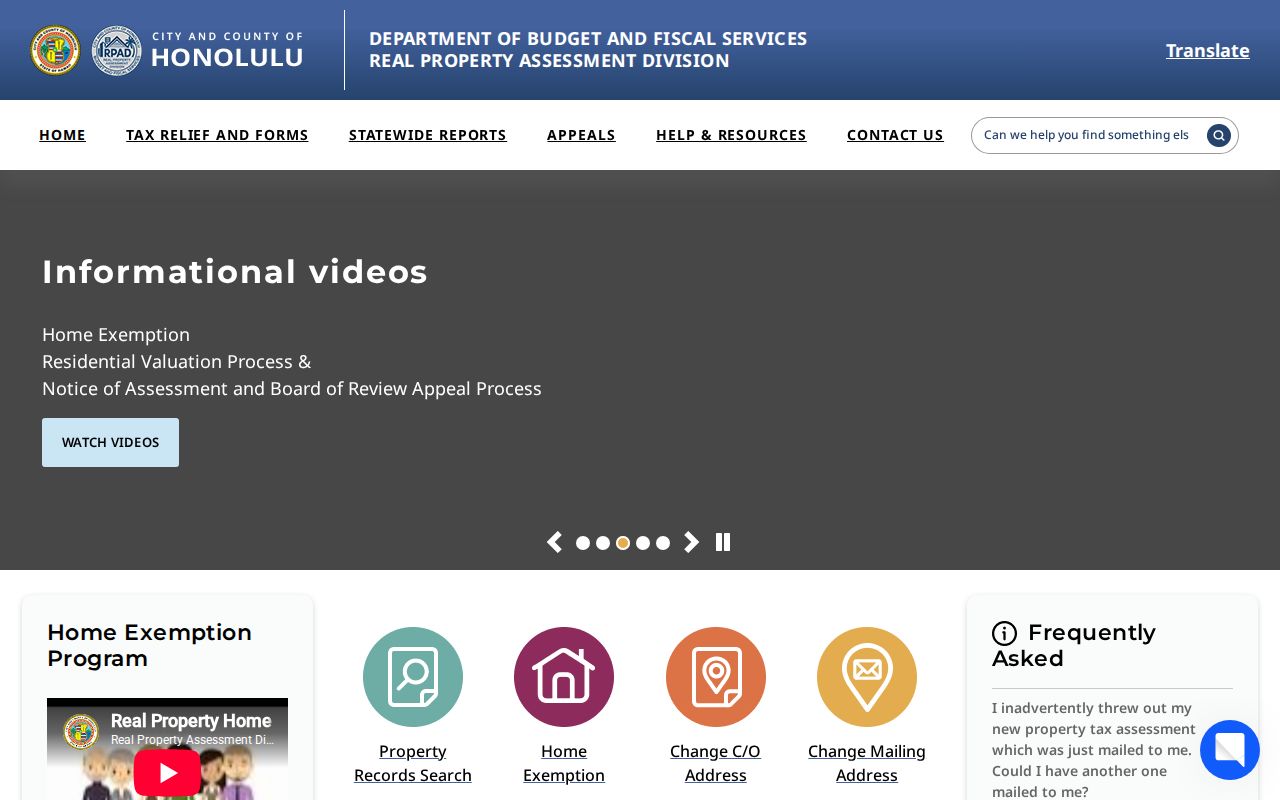
The RPAD entry screen is the official county starting point even though Kaneohe lies across the Koʻolau range from the main Honolulu counter.
Note: Preserve the exact TMK and source date before moving from RPAD to deeds, permits, or court records.
Kaneohe Deeds Cross the 1976 Line
The Bureau of Conveyances online services place recorded parties into a statewide index. A free registered account can search the index, while document images and downloads carry charges. Online indexing and copies generally reach back to 1976. Recent instruments may need a written request, and blurred previews are not valid copies. The Bureau’s archive itself reaches to 1845, so an older Kaneohe trail is not lost simply because it does not appear on the web.
Before 1976, use the Public Research/Reference Room on business days from 8:15 a.m. to 3:30 p.m., or submit the Bureau’s written search form by mail or at the counter. Supply party names, document or book and page if known, property location, TMK, approximate date, document type, return information, and whether certification is needed. The FAQ lists $35 per document plus $10 processing for this older-record path, but the office should confirm the amount before payment.
| BOC search control | Use in a Kaneohe search | Format note |
|---|---|---|
| Grantor or grantee | Find a seller, buyer, or earlier title party | Name mode |
| TMK | Hold the search to one parcel | Shown as 1-1-1-111-111 |
| Recording date | Narrow a known transfer period | Date or range |
| Document number | Return to a known instrument | Number style changes by era |
| Land or number type | Separate Abstract, Torrens, or Land Court | Advanced control |
The captured Bureau page shows where a Kaneohe resident records search begins. It also makes the account boundary clear before a reader expects free document images.
View the BOC online-service instructions before using the registered search.
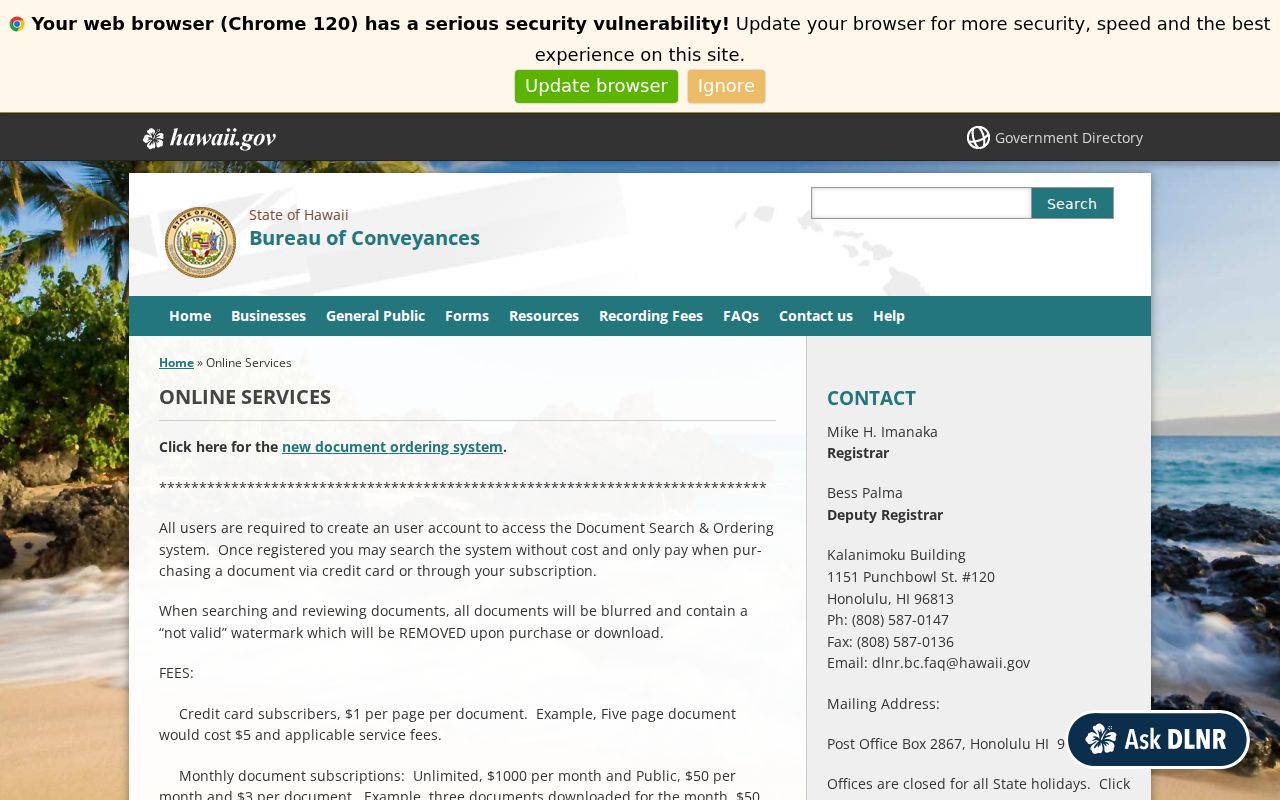
The screen belongs to the statewide recorder, which is why a Kaneohe deed search is not filed through a separate Honolulu county recorder.
Current Kaneohe Directory Sources
Current records list roles, not complete households. The property roll names assessed parties. Recorded instruments name parties to land documents. Court results name parties in cases. Election records expose limited fields in an election context, while OLVR is the voter’s own confirmation tool. Public civic minutes may name speakers or officials but do not form a member roster. Read each result by its stated purpose and date.
| Source | Who It Lists | Keeper | Access |
|---|---|---|---|
| RPAD parcel roll | Fee owners and some assessment parties | Honolulu RPAD | Web, phone, counter, request |
| BOC document index | Grantors, grantees, lien and title parties | Hawaiʻi BOC | Free account search; paid images |
| eCourt Kōkua | Public case parties | Hawaiʻi Judiciary | Web, terminal, clerk request |
| Election records | Name, district or precinct, and status where lawful | Honolulu Elections | Purpose-limited; OLVR is self-service |
| Civic records | Officials, speakers, and named participants | City departments and NCO | Notices, minutes, UIPA request |
A modern name can also be checked in Hawaiʻi Business Express, DCCA professional-license records, state unclaimed property, or an obituary source when the person’s role fits. Those systems may show an entity, license, claim, or historical notice, not a home. For a focused name-in, records-out method, use the Kaneohe resident lookup page and keep the same-name safeguards in place.
Kaneohe Voter Records Stay Narrow
Hawaiʻi Online Voter Registration lets a voter register, update, or confirm that voter’s own record. The service requires a Hawaiʻi driver license or state ID and the last four digits of the Social Security number. It is not a public name-to-address directory. A voter without the needed ID can use the paper process or contact Honolulu County Elections at 808-768-3800.
HRS §11-97 treats full name, district or precinct, and voter status as public within the election-data setting, but protects other affidavit data. Hawaiʻi does not register voters by political party, and no public ballot-choice history exists. Countywide exports are a separate election-administration product, not the OLVR screen. The residents directory should therefore label an election result as voter status, never as proof of a current household.
Open the official OLVR service to see the self-confirmation entry point.
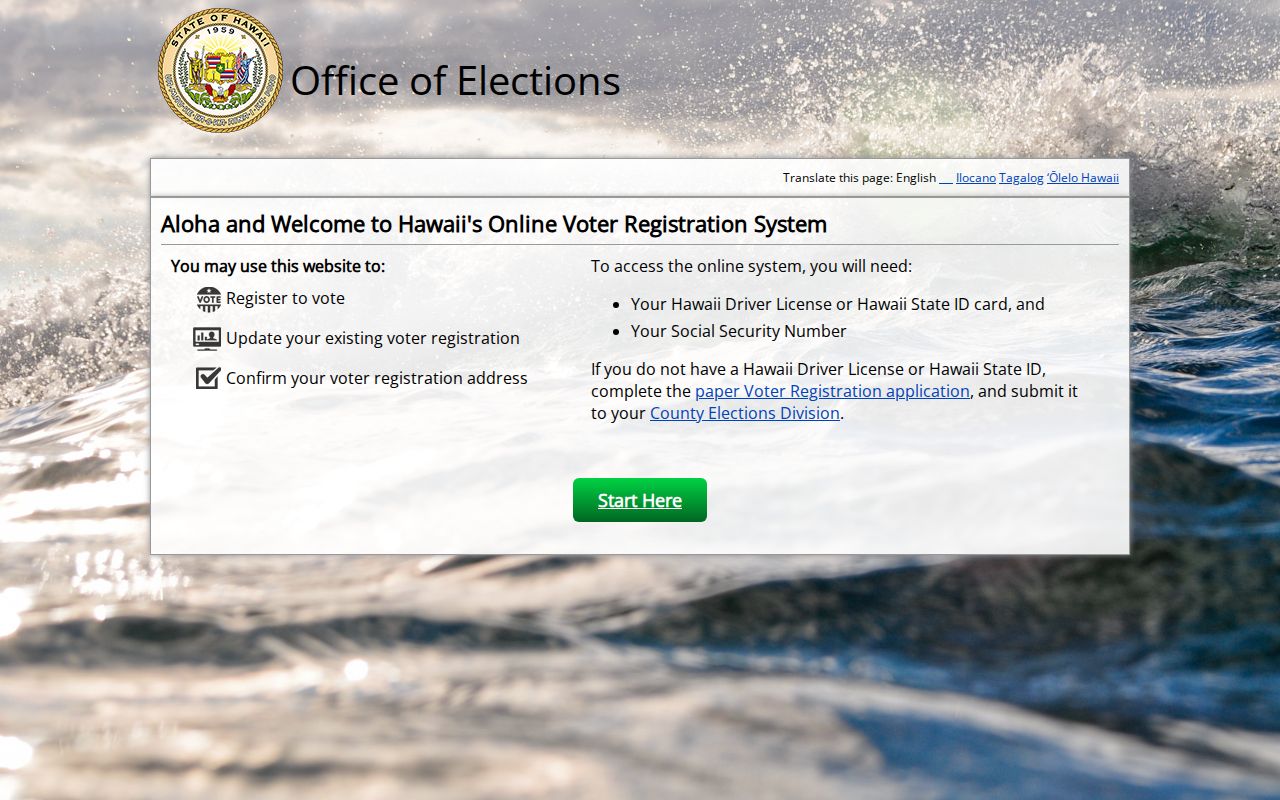
The screen asks for private credentials because it serves the voter whose registration is being checked, not a visitor browsing nearby names.
Lawful use. Kaneohe records may support family research, civic review, reconnection, and personal safety. Never use them to track, threaten, or harass anyone.
Checking Kaneohe Court Name Matches
The statewide eCourt Kōkua access page points to District, Circuit, Family, Land, Tax Appeal, and appellate case information. Person Search requires first and last name. Optional middle name, date range, case type, phonetic search, and partial search help narrow results. A result may show the case ID, case type, status, filing date, court, location, party role, aliases, events, and disposition. It does not establish that a same-named person is the Kaneohe resident sought.
Compare the middle name, court, filing date, party role, and any address fact that can be lawfully confirmed. Older online coverage varies by case type, and sealed, juvenile, or confidential material does not appear. Basic information is free. Public PDFs cost $3 for the first 30 pages, then ten cents per page. The public terminal at Kaneohe District Court offers another access channel, and First Circuit clerks accept inspection, search, plain-copy, and certified-copy requests when the portal lacks the needed file.
Note: Call Kaneohe District Court at 808-534-6300 before visiting because a current web schedule and an older request form list different hours.
Kaneohe Certificates Have Eligibility Rules
Birth, marriage, and death certificates for Kaneohe events come from the State Department of Health, not a county clerk. HRS §338-18 and Hawaiʻi Administrative Rules §11-117 keep vital records from ordinary public inspection. A certified copy requires a direct and tangible interest, such as the registrant, spouse, parent, descendant, common ancestor, guardian, authorized representative, estate representative, qualifying co-owner, or a court order. The rule does not make a death certificate freely open merely because the person died.
Eligible applicants can use the DOH online, mail, or counter channels. The base charge for a birth or marriage certificate is $10 for the first copy and $4 for each additional copy, plus listed administrative costs. Ordinary processing is stated as four to six weeks. Genealogy access follows a rolling 115-year rule, so in 2026 it applies to events before 1911. Divorce decrees after February 1, 2026 come from the Judiciary because DOH stopped maintaining new divorce records.
The captured DOH page helps a qualified Kaneohe requester choose an order path before sending identification and payment.
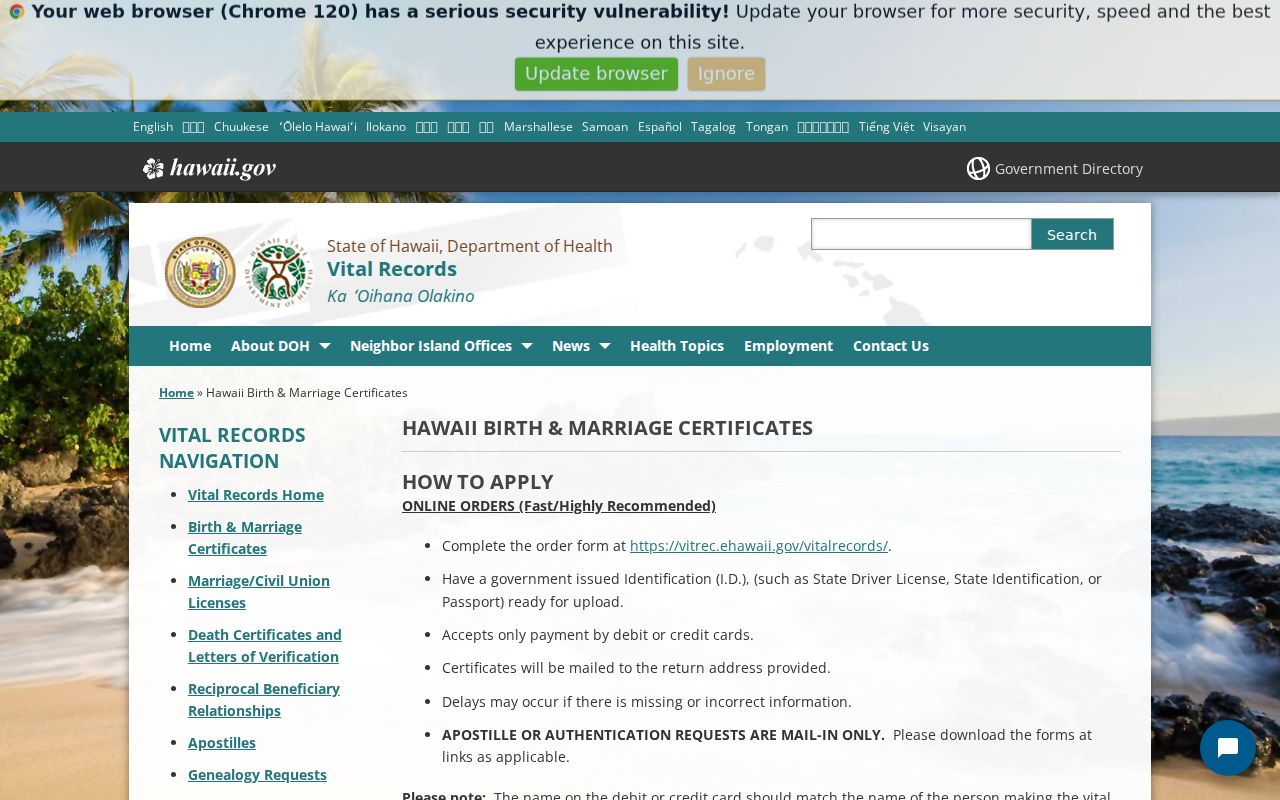
It also marks a key limit: the certificate desk is an issuance service, not a public resident-name search.
Historical Kaneohe Residents Directory
Kaneohe appears within broad Honolulu and Hawaiʻi Territory volumes rather than a neat Kaneohe-only book. The printed run begins with the 1869 Honolulu Directory, then passes through McKenney, Husted, Polk-Husted, and Polk titles. Hawaiʻi State Archives and the Hawaiʻi State Library’s Hawaii and Pacific collections hold the core shelves, while UH eVols offers selected scans. No volumes were issued in 1943 through 1946, 1950, or 1952, so a missing name in those years may reflect a publication gap.
Search Kaneohe and Kāneʻohe, Heeia and Heʻeia, Kahaluu and Kahaluʻu, old road abbreviations, rural routes, business addresses, and military labels. An entry may give a name, occupation or status, address, year, page, and sometimes a widow notation. It is a period lead, not certified residence proof. The full collection table and entry-reading method are on the Kaneohe city directory page.
Hawaiʻi public-library genealogy services provide Ancestry Library Edition at branch computers or Wi-Fi, HeritageQuest with a library card, and staff help.
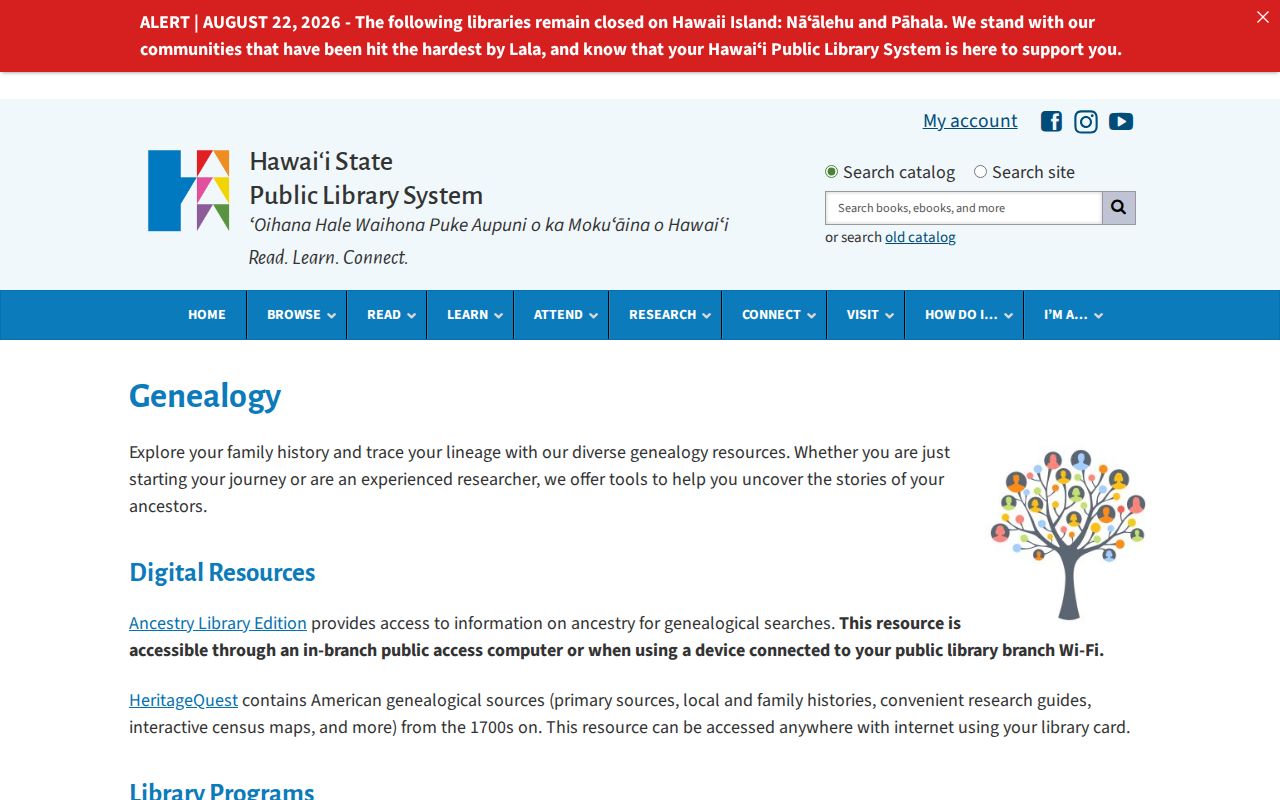
The library route matters when an old directory, newspaper index, or licensed database is not freely searchable from home.
Kaneohe Archives Search Beyond Directories
Hawaiʻi State Archives adds probate, will, vital-statistics, naturalization, passport, land, court, government, and obituary indexes to the historical resident trail. Its obituary index covers 1836 through 1950, mainly in English-language Honolulu papers. Digital Archives search accepts keywords, wildcard characters, Boolean terms, and exact or ranged dates. Not all indexes or underlying files are online. In January 2026, the Archives announced thousands of new index pages, but onsite staff and written copy requests remain part of the access chain.
Bring names, approximate dates, relatives, island, occupation, and record type to the Archives at 364 South King Street. It is open Monday through Friday from 9:00 a.m. to 4:00 p.m.; requests and forms are accepted until 3:30 p.m. Visitors may use a free self-service scanner with their own USB. UH’s Oʻahu Cemetery Index, Chronicling America newspapers, public-library microfilm, and released census schedules can corroborate a directory hit without turning any single clue into a claim of current residence.
When Kaneohe Portals Stop
A blocked or incomplete web screen is the start of a fallback, not evidence that no record exists. Use the portal’s phone or email, visit its counter or public terminal, mail the published form, ask a library or archive reference desk, or file a narrow request under the Hawaiʻi Uniform Information Practices Act. The request should name the agency, record type, date span, person or TMK, desired electronic format, and whether a redacted version would suffice.
The Office of Information Practices explains that any person may request open government records, subject to HRS §92F-13 and other confidentiality laws. Agencies need not create a new list that is not readily retrievable. Guidance lists search at $10 per hour and review or segregation at $20 per hour, with an automatic fee waiver and possible advance payment. A UIPA request does not override vital-record, voter, court, DMV, or Address Confidentiality Program protections.
Kaneohe Geography Changes the Match
Kaneohe can mean a census place, postal city, civic district, ahupuaʻa, military label, or broad community. The 2012 Honolulu Street Index shows why the label matters: Kaneohe Bay Drive crosses Kailua 96734, Kaneohe 96744, KMCAS 96734, and MCBH 96863 contexts depending on the house range. A person or parcel can look misplaced when the source simply uses a different geography.
Keep the exact label and date from the record. Search Heʻeia, Kahaluu, Ahuimanu, MCBH, KMCAS, Kaneohe Marine Corps Air Station, and Windward place names where relevant. Modern ZIP codes should not be projected backward onto Kingdom or Territory directories. Likewise, the Kaneohe CDP, Kaneohe Station CDP, Neighborhood Board #30, postal delivery area, and county parcel layer do not share one border.
Windward Satellite City Hall information shows the local service counter at 45-480 Kaneohe Bay Drive.
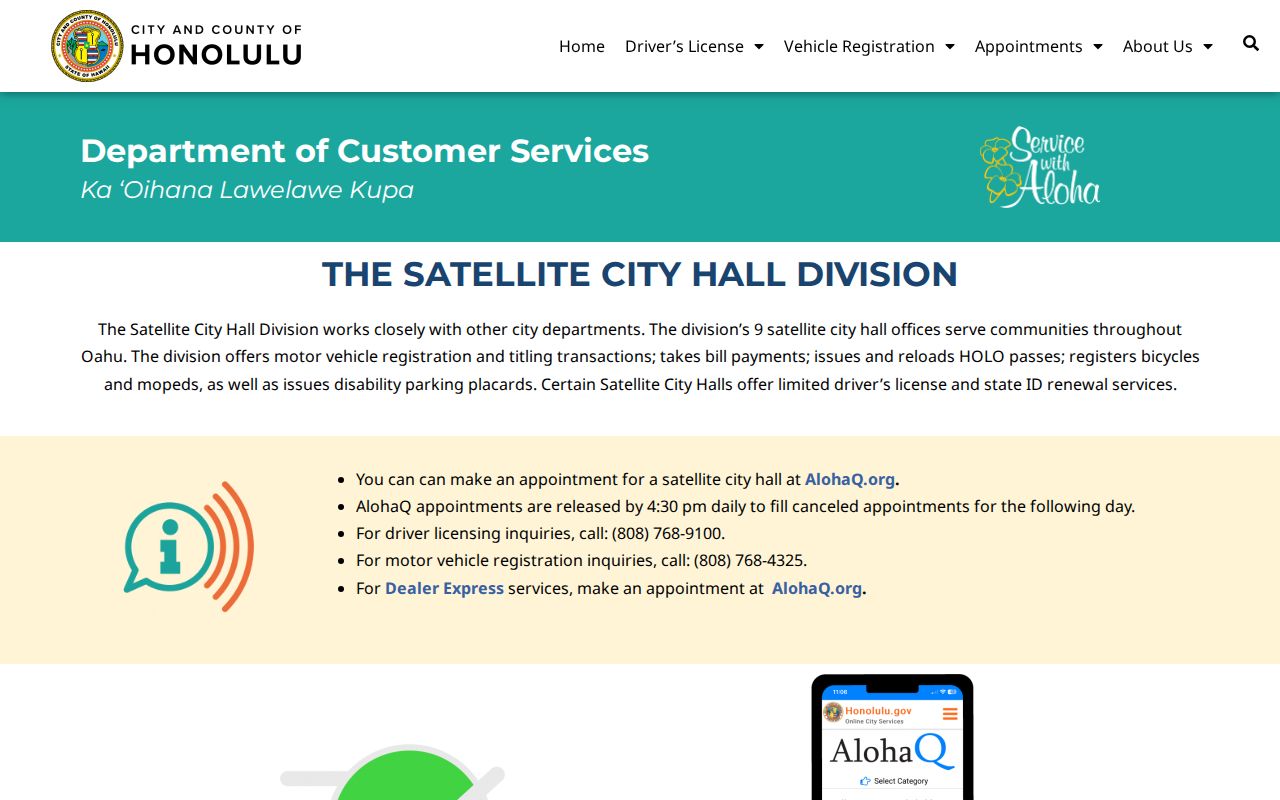
The office can route selected county services nearby, but central assessment, deed, court, archive, and vital-record work still follows each custodian’s channel.
Kaneohe Search Logs Prevent Mixups
Record the query, spelling, date, portal, geography, and result role after each search. Mark an RPAD hit as an assessed owner, a BOC hit as a recorded party, an eCourt hit as a case party, and a directory entry as a historical lead. Save the TMK, document number, case ID, directory year and page, or archive call detail that lets another person reproduce the search. This small habit is the best defense against same-name errors.
Official sources and commercial compilations serve different purposes. Official rolls have a named custodian, a defined reason for collection, a correction route, and known access limits. Commercial people-finder data may blend stale or unrelated sources and rarely carries the same proof trail. Use the official source for the fact being claimed, verify it with the custodian when the result matters, and leave protected people and closed fields alone.
| Source type | Best use | Main caution |
|---|---|---|
| Official roll or index | Role-specific, source-dated fact | May omit occupants or older files |
| Library or archive | Historical household and context | Coverage and spelling vary |
| Commercial compilation | Unverified lead only | Stale merges and unclear provenance |