
Kaneohe Previous Resident Sources
No single roll spans the whole life of a Kaneohe address. Start with the source closest to the target year, then use a second record with a different purpose. The table distinguishes owners, occupants, events, and property work.
| Source | Documented span | Custodian | Evidence |
|---|---|---|---|
| BOC deed index | Online generally 1976 forward; archive to 1845 | Hawaii Bureau of Conveyances | Grantor, grantee, instrument, date, legal land |
| Polk and Husted directories | Selected volumes from 1869 onward | State Archives, UH, HSPLS | Name, occupation or status, and address leads |
| Federal census | Released schedules from 1900 onward for Hawaii | NARA and library databases | Households within dated geography |
| DPP permits | Record-specific | Honolulu DPP | Application, TMK, status, approvals |
| Obituary index | 1836 to 1950 | Hawaii State Archives | Death, newspaper, and family lead |
For a recent title question, begin with RPAD and BOC. For a mid-century household, start with a directory or census, then check deeds and newspapers. Earlier work relies more on archival indexes, land books, church or community evidence, and staff help. A blank year is not proof that no one lived there.
Fix the Kaneohe Parcel First
Preserve the current address exactly as USPS and RPAD show it. Save the RPAD access date, site address, owner, TMK, and any legal-description clue. Then open HoLIS and record the mapped parcel and nearby lot numbers. The same road can cross more than one postal or community label, so a house number and road name are not always enough.
A site address marks the physical property. A tax mailing address is used for correspondence. The deed's legal description ties the transfer to land. Keeping those fields separate is an insider step that prevents the search for previous residents from drifting to the owner's mailing address or a similarly named parcel.
Kaneohe Deeds Cross a 1976 Line
The BOC online index generally begins in 1976. Registered search access is available online, while document images involve payment. When the chain crosses the cutoff, use the Public Research and Reference Room, which the research records as open from 8:15 a.m. to 3:30 p.m., or submit the written search request. Older land records extend to 1845.
The form and reference staff matter because a search can continue through book, page, Liber, certificate, map, or other older references even when an image is absent online. Confirm current charges with BOC before ordering. The documented pre-1976 copy route listed a document charge plus processing, but fees can change.
Note: The end of an online index is a channel change, not the end of a Kaneohe title trail.
Trace Kaneohe Owners Backward
The chain of title is the linked sequence of transfers for the same land. Start with the present assessment owner, but rely on the recorded instrument to establish a transfer. Names alone are weak continuity evidence. Match the TMK, legal description, dates, and party roles throughout the Kaneohe previous residents search.
- Pull the current fee owner, TMK, site address, and land description from RPAD and HoLIS.
- Search BOC for the current owner as grantee and identify the purchase deed.
- Record its grantor, grantee, instrument, date, number, and parcel description.
- Search that seller as an earlier grantee, then repeat while the land details agree.
- Switch to the reference room, written request, maps, and archive sources before the online run.
- Grantor and grantee
- The grantor transfers an interest; the grantee receives it.
- Chain of title
- The linked sequence of recorded transfers for one parcel.
- Legal description
- Land-identifying words and numbers that can remain useful when a street label changes.
A trust, company, married name, or spelling variant can interrupt a name-only search. Use the parcel description and dates to bridge that break. Mortgages, liens, and releases belong in the property story, but none automatically marks a new owner.
Read the Kaneohe Index Screen
The successful manifest capture comes from the BOC eSearch entry. It shows the account-based doorway used for the modern recorded-document search.
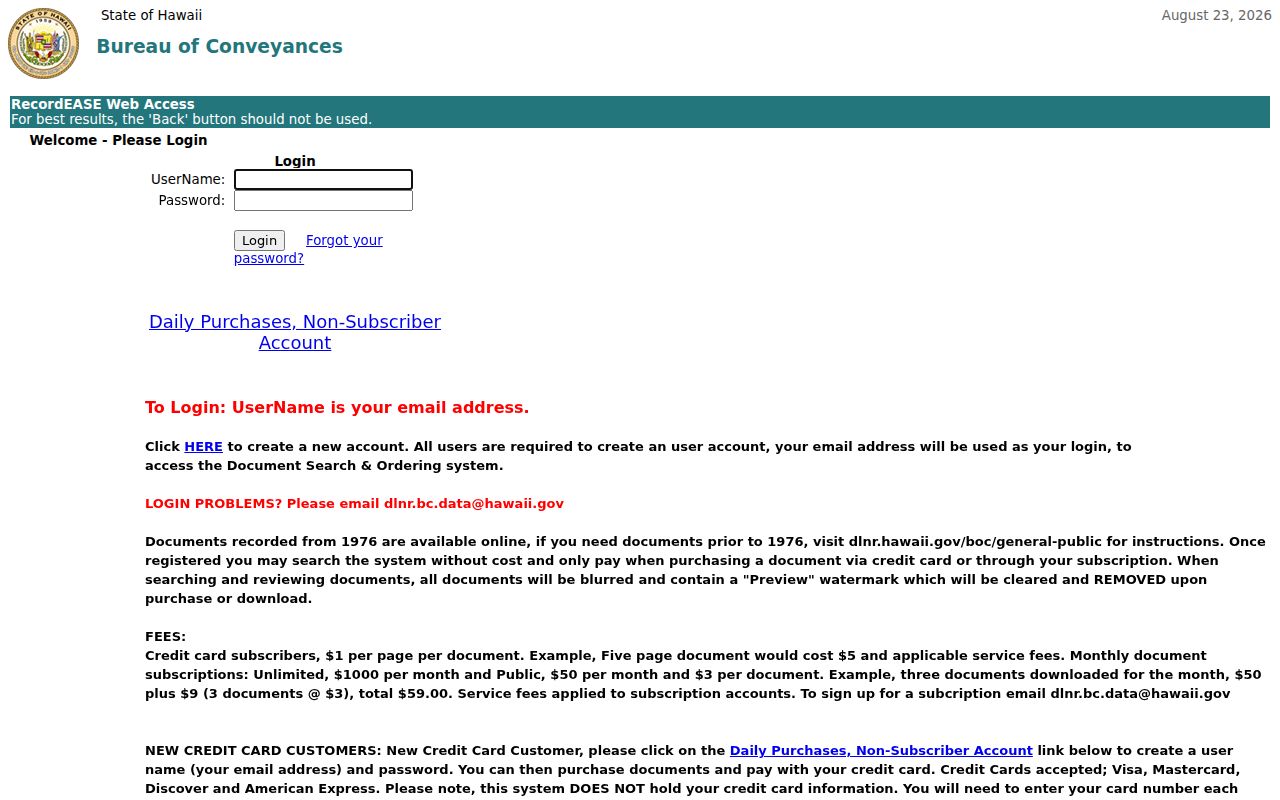
The screen is a starting point, not a complete deed. Log the index result and obtain the instrument or certified copy when the legal record itself matters. BOC searches are statewide, so confirm that the legal description and TMK point to the Kaneohe parcel.
Build a Kaneohe House File
The Historic Hawaii Foundation house-history guide recommends a research stack rather than one database. It points to State Archives photographs and aerials, Bureau of Conveyances records, State Library newspapers and maps, DPP permits, RPAD profiles, UH Hamilton Library, Bishop Museum, Mission Houses, historical organizations, and local collections.
Create one dated row per source. Keep images, citations, names, land identifiers, and the exact claim in separate columns. An aerial can show a structure, a permit can date work, and a deed can establish a transfer. None of those alone identifies every past resident. This disciplined file makes conflicts visible instead of smoothing them away.
Kaneohe Sanborn Maps Have a Gap
The Library of Congress Hawaii Sanborn guide describes fire-insurance maps for Hawaii places and notes that digitized public-domain maps can be searched. Research confirmed Honolulu examples for 1927 and 1955, but it did not confirm a Kaneohe sheet or year. Do not assign those Honolulu dates to a Kaneohe house.
Maps still belong in the search as a question for the State Library, State Archives, UH, and local reference staff. If no sheet exists, use plat maps, historic aerials, permits, tax records, directory street pages, and photographs. An explicit gap is stronger than an invented map date.
Keep Kaneohe Addresses Continuous
No official source established a citywide Kaneohe street-renumbering year. Use the dated 2012 Honolulu Street Index, old directory spellings, USPS address format, TMK, and deed description together. Kaneohe Bay Drive is especially tricky because its house ranges cross Kailua, Kaneohe, KMCAS, and MCBH labels with different ZIP contexts.
Write the original label beside each historical hit. Do not force an old rural route, military label, census place, or community name into the present postal city. A legal parcel match can show continuity even when the words on the address line differ.
Note: Preserve Hawaiian diacritics and also test plain-letter spelling variants when an older index does not support them.
Kaneohe Past Households Beyond Deeds
Owners are only one part of the address story. Printed reverse directories can place a listed occupant at a street address, while released census schedules may show household members within the geography used that year. The Kaneohe city directory page covers publishers and holdings in depth. Here, use each volume as one dated point in the backward trail.
- Choose a directory year close to the target date and search street, locality, rural route, and surname forms.
- Copy the entry, page, publication year, spelling, occupation or status, and exact address.
- Check the nearest released census by name and geography, allowing for enumeration boundaries.
- Compare deed dates, permit records, and newspapers before assigning the household to the parcel.
- Repeat with the next directory year and mark every gap rather than assuming continuity.
The researched shelf has missing volumes for 1943 through 1946, 1950, and 1952. A name's absence in those years says nothing about a move. Hawaii State Archives' obituary index covers 1836 to 1950 and points to newspaper microfilm. The UH Oahu Cemetery Index, probate files, and newspapers can add death, family, or heir clues. None automatically proves the person's last address.
Lawful use. Research Kaneohe previous residents for house history, genealogy, heirs, or personal curiosity. Never use a record trail to track, harass, intimidate, or harm a living person.
When Kaneohe Online Records End
Use every documented channel. Search Hawaii State Archives Digital Archives and UH eVols first, then ask Hawaii State Public Library System reference staff about printed directories, reverse volumes, newspaper indexes, and microfilm. State Archives staff can help with onsite or index-only material. Family History Centers and library-licensed genealogy databases provide another route to census and index records.
For the legal parcel anchor, use RPAD/qPublic and HoLIS online, BOC eSearch or its room and written form, DPP's permit search and DAIB, and a focused UIPA request to the actual custodian. Phone, mail, and counter service are not lesser evidence. They are often the only access path to an older or non-digitized record.
Previous residents should be described by source role: assessment owner, deed party, directory occupant, census household member, permit applicant, obituary subject, or probate party. That wording keeps a useful Kaneohe history accurate even when the record run is incomplete.
Keep a citation for every row in the house file. Record the agency or collection, title, year, page or instrument number, search date, and the exact form of the name and address. Mark an inference as an inference. Two people with the same name are not one person until dates, relatives, geography, or another stable fact supports the match. The same care applies to trusts and business entities in the deed chain.
Recent digital work does not erase onsite gaps. Hawaii State Archives added thousands of index pages across genealogy, land, court, and government collections in January 2026, making its digital search a useful first pass. Index pages may lead to records that still require staff help or a copy request. Treat new access as a better doorway, not as proof that all Kaneohe records have been digitized.