
Kaneohe Directory Collections by Era
Kaneohe has no stand-alone run in these collections. The useful city directory shelf is the Honolulu and Hawaiʻi sequence held by the Hawaiʻi State Archives, the Hawaiʻi State Public Library System, and selected University of Hawaiʻi scans. Kaneohe residents sit inside those wide geographic volumes. Search the locality pages as well as the alphabetical name pages. A single person may be filed under Kaneohe, a rural route, an island business address, or an older road form. Checking every label is part of the work.
| Collection | Years or run | Where kept | Access path |
|---|---|---|---|
| Honolulu Directory | 1869 | HSPLS lead | Library catalog and shelf |
| McKenney's Hawaiian Directory | 1884 | HSPLS Hawaii & Pacific | Printed reference |
| Husted directories | 1898/99 and 1900/01 | HSA and HSPLS | Onsite reference |
| Polk-Husted Directory | 1902 to 1940 | HSA, HSPLS, selected UH scans | Shelf and partial digital access |
| Polk's Directory | 1941 onward, with gaps | HSA and HSPLS | Printed reference |
| Hawaiian Kingdom directory | 1880 to 1881 | UH eVols | Digitized item |
Treat the table as a route map. It does not promise that every year is present. The library guide reports no issued directories for 1943 through 1946, 1950, or 1952. Later holdings are only partly cataloged. So confirm a volume with staff before making a special trip. When an index allows it, search both Kaneohe and Kāneʻohe spellings.
Kaneohe Directories Change Publishers
Publisher history matters, because catalog searches often need the formal book name. The 1869 volume was the Honolulu Directory, and historical sketch of Hawaiian/Sandwich Islands. McKenney issued a Hawaiian directory in 1884. Husted titles followed in 1898/99 and 1900/01. Polk-Husted then covered the City and County of Honolulu and Territory of Hawaii from 1902 through 1940. Polk's own title began in 1941.
| 1869 | First directory title in the documented run |
|---|---|
| 1884 | McKenney city directory and handbook |
| 1898 to 1901 | Two Husted title forms |
| 1902 to 1940 | Polk-Husted city, county, and Territory sequence |
| 1941 onward | Polk title, with later holdings requiring confirmation |
A catalog miss under "Kaneohe city directory" proves nothing. Useful books still exist under broader titles. Repeat the search with Honolulu, Oahu, Territory of Hawaii, Polk-Husted, and the target year. The wide title itself is evidence of how Kaneohe was organized in print.
Note: Known publication gaps can explain a missing annual entry, so do not treat every absent name as proof that the person moved.
Digital Kaneohe Directory Routes
Online access helps, but it is incomplete. The UH eVols 1880–81 item offers metadata plus a digitized Hawaiian Kingdom directory. The Archives city-directory page lists selected eVols years from 1880–81 through 1924. The years include 1884–85, 1888, 1889, 1890, 1892, 1894–95, 1896–97, 1898, 1902, 1903–04, 1904–05, 1905–06, 1910, and 1913.
The Hawaiʻi State Digital Archives accepts wildcard searches, Boolean terms, and exact or ranged dates. It works collection by collection. A blank result does not prove the archive lacks a person or volume. A January 2026 update added thousands of index pages. They come from genealogy, land, court, and government groups. Onsite indexes still fill major gaps.
Open the official State Archives city-directory holdings page before checking any year. It also helps before planning a visit.
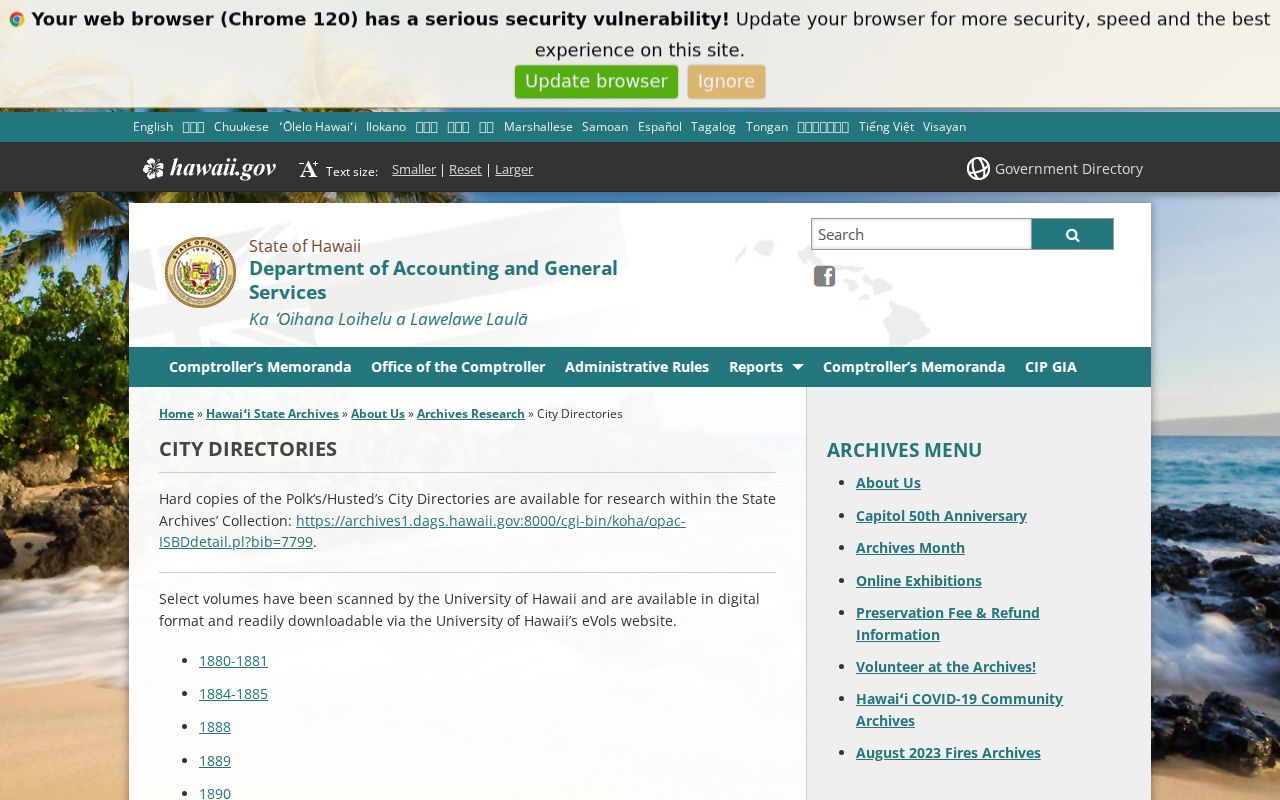
The State Archives city-directory page connects Kaneohe research to the state catalog and selected online volumes. It points toward broader island records rather than a complete Kaneohe-only database.
Read Kaneohe City Directory Entries
A city directory entry is a dated clue, not a biography. It may list a name, an occupation or status, a residence, a marital or widow notation, and sometimes a business or household tie. Exact fields and abbreviations shift by edition. Joseph Pestama appears as "luna" in 1929–30. T. Kurita shows up as an assistant chemist in 1934–35. Frank Vierra carries a widow-related status note in 1929–30, while Caesar Book is identified as a locomotive engineer in 1934–35.
| Indexed name | The form printed in that edition, including initials |
|---|---|
| Occupation or status | A role that can distinguish people with similar names |
| Year and page | The citation needed to find the entry again |
| Residence or business | An address when that edition includes one |
| Family notation | A spouse, widow, or household clue when printed |
Do not add fields the scan does not show. The local examples establish names, status, year, and page. They do not prove a universal owner mark or spouse format, so photograph each edition's key before decoding any short form.
- Criss-cross directory
- An address-first section arranged by street and house number rather than surname.
- Householder index
- An index centered on the named householder, not all occupants.
- Abbreviation key
- The volume's legend for occupation, residence, marital, and address shorthand.
Kaneohe Directory Help Beyond Screens
When the digital run ends, call on reference staff. The HSPLS genealogy service provides Ancestry Library Edition on public computers and Wi-Fi, HeritageQuest with a library card, research videos, and librarian help. Ask about Hawaii & Pacific holdings, telephone books, reverse directories, obituary indexes, newspaper microfilm, and yearbooks. No Kaneohe-specific reverse-directory scan appears online. The reference desk is the correct fallback.
Hawaiʻi State Archives
364 South King Street, ʻIolani Palace Grounds
Honolulu, HI 96813
808-586-0329
Monday through Friday, 9:00 a.m. to 4:00 p.m.
Library Research
Start at a public branch, then ask for Hawaii & Pacific shelves, genealogy databases, newspapers, and city directory volumes.
Archives staff recommend sending names, rough dates, relatives, island, occupation, and record type. Requests and forms are accepted until 3:30 p.m. A free self-service scanner is available for researchers with their own USB. Travel from Kaneohe can be impractical. In that case, mail requests and staff copies offer workable alternatives.
Trace Kaneohe Families Across Years
Consecutive city directories can bridge the ten-year gap between federal census releases. A change in street or occupation may mark a move. A change in initials or family notation may mark a life event. Each change still needs support from another record. Keep the directory's exact geography label. Kaneohe, rural Oahu, and a Honolulu business address may describe different parts of one person's life.
- Begin with a name, address, occupation, spouse, or likely year and locate the alphabetical entry.
- Record the title, publisher, year, page, spelling, locality, and every abbreviation.
- Check the next available editions, noting first and last appearances, moves, and status changes.
- Pair the nearest directory with a released federal census while preserving its geography.
- Test the trail against a deed, probate file, newspaper notice, obituary, or cemetery entry.
Disappearance can mean a skipped volume, a move, a death, a new spelling, an unlisted household, or a changed locality. Each cause deserves a check before a conclusion. The Kaneohe resident lookup can help verify a modern name found at the end of the historical trail.
Kaneohe Directory Companion Records
Old newspapers and death records can fill gaps. A slim city directory line often leaves details out. The State Archives obituary index reaches from 1836 to 1950. It draws mostly on English-language Honolulu papers. Chronicling America adds historic Hawaiian titles. These include the Hawaiian Gazette, Pacific Commercial Advertiser, and Honolulu Daily Bulletin. Coverage is uneven, though. Optical character recognition also misreads Hawaiian names, so spellings deserve patience.
The UH Hawaiʻi Cemetery Index searches by surname or cemetery and covers Oahu. A cemetery hit is a death or interment lead, not proof of a Kaneohe address. Probate files, wills, and deeds can then link relatives to property. Trust sources that agree over any single apparent match.
Kaneohe City Directory Limits
A printed Kaneohe directory is a lead, not proof. It cannot confirm where someone lives now. It also cannot confirm who owned a home or how a family fit together. Many old volumes list just one householder per street address. They leave out everyone else under that roof. A shop address sometimes stands in for a residence. Early books also cover a wider territory than the modern city. So today's ZIP code boundaries should never be laid over an old street entry.
Treat every line as a clue and keep the citation with it. For current ownership, check the parcel rolls and deed indexes at the recorder or assessor. To trace historical kin, lean on census schedules, probate files, obituaries, and cemetery records. Add vital indexes too. Hawaiʻi keeps vital certificates restricted, and no directory citation unlocks a certified copy. Keeping leads, indexes, images, and certified records separate keeps the family story straight.
Note: A directory's printed date reflects its publication period, though the facts inside were often gathered weeks or months earlier.